
Madras HC Quashes TN Rule Banning Mineral Transport To Other States

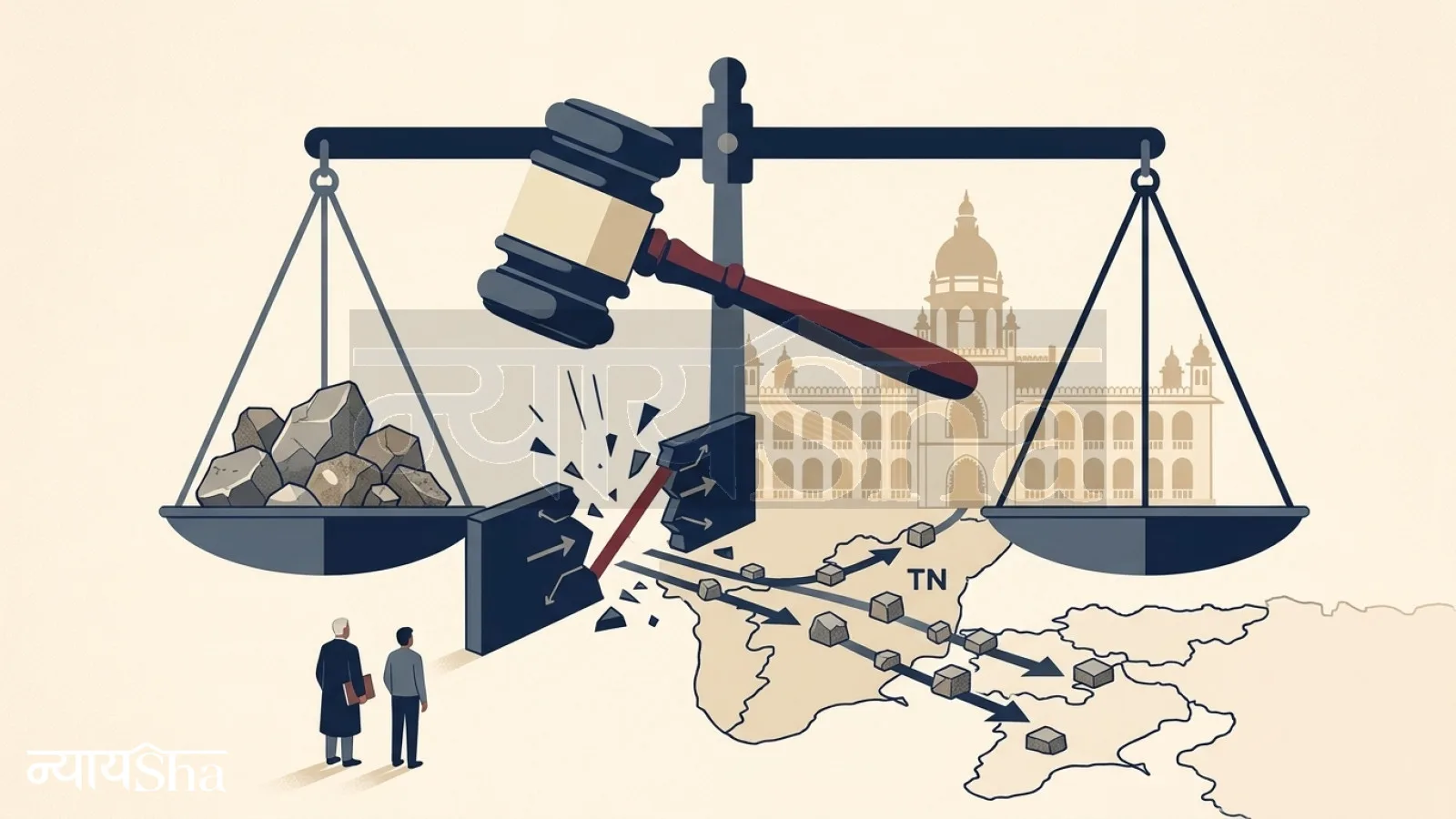
The Madras High Court has struck down a Tamil Nadu government provision that allowed authorities to block the movement of rough stone and other minerals from the state to other parts of the country, ruling that the restriction violated the constitutional guarantee of free trade.
A Division Bench of Chief Justice Sushrut Arvind Dharmadhikari and Justice G Arul Murugan declared Rule 3-A of the Tamil Nadu Prevention of Illegal Mining, Transportation and Storage of Minerals and Mineral Dealers' Rules, 2011 unconstitutional. The Bench also quashed a July 27 government order that had imposed a three-month ban on transporting rough stone and aggregates beyond Tamil Nadu's borders.
The petitions were filed by mining leaseholders and stone crusher operators against Rule 3-A, which was brought in through a government notification dated July 9, 2026. The rule had given the Director of Geology and Mining powers to control the inter-state transport of rough stone, boulders, M-sand, metal jelly and similar construction materials, including the authority to impose temporary bans to protect local supply. Acting on this power, the Director had ordered a three-month ban on July 27, sparing only Puducherry and Karaikal.
Petitioners' Challenge To Rule 3-A
The petitioners argued that Sections 15 and 23-C of the MMDR Act gave the state no authority to control the sale or movement of minerals once they had been legally mined and royalty had been paid. They further contended that the ban breached Article 301 of the Constitution, which protects freedom of trade and commerce across the country.
The state government defended the rule by citing its regulatory powers under Section 23-C of the MMDR Act, claiming the ban was meant to balance local demand, safety concerns and material availability. It also argued that unchecked inter-state movement had led to minerals being routed largely toward Middle Eastern markets, and pointed out that the three-month ban period had already lapsed, making the case largely academic.
Why The Court Found The Ban Unconstitutional
The High Court was unconvinced by the state's defence, leaning on the Supreme Court's ruling in State of Gujarat v. Jayeshbhai Kanjibhai Kalathiya. The Bench explained that Section 23-C exists solely to check illegal mining, transport and storage, and cannot be stretched to cover minerals extracted through lawful means.
"Once the State has permitted mining and allowed the excavation of minerals, imposing a temporary ban on their transport to other States has no rationale or reasonable nexus with the object that is sought to be achieved," the Court observed.
The judges added that any state action banning inter-state mineral transport or curbing sales — outside what is permitted under Part XIII of the Constitution — would be unconstitutional and would exceed the legislature's competence.
What The Ruling Means For Mining Leases
The Bench clarified that once minerals are extracted under a valid lease in compliance with statutory norms, ownership transfers to the leaseholder. States, it noted, retain the power to impose reasonable conditions at the stage of granting leases, and can regulate aspects like maximum load limits, speed restrictions and public safety.
What states cannot do, the Court made clear, is use these powers to directly block the sale of minerals or stop their movement to other states.
With this reasoning, the Bench allowed the batch of petitions, holding Rule 3-A unconstitutional and beyond the rule-making authority granted under Sections 15 and 23-C of the MMDR Act.
Senior Advocates ARL Sundaresan, Srinath Sridevan, Satish Parasaran and Ajmal Khan, along with advocates Sanjeevi and Puhazh Gandhi, represented the petitioners. Advocate General Vijay Narayan appeared for the Tamil Nadu government, assisted by Special Government Pleader J Lenin and Government Advocate Akash Srinanda.
Related Reads
- Madras HC Dismisses PIL On Vimal Elaichi Pan Masala Ad
- Madras High Court: Prosecutors Can't Be Hauled Up For Misconduct Merely For Disagreeing With Police On Bail Or Evidence
- Supreme Court Upholds Order Mandating FIR Registration in Tamil Nadu Cash-for-Jobs Scandal
- Madras High Court: Settlements Reached Post-Evidence Won't Entitle Litigants to Court Fee Refunds
- Supreme Court Lets Off TN Police Officer With Caution, Wipes Clean Harsh Madras HC Remarks
Follow Nyaysha
Fresh legal updates across our platforms — follow wherever you already scroll.
LinkedInJudgments, appointments & career moves — for professionals Follow Instagram@nyaysha.in — visual explainers, reels & court-room snapshots Follow FacebookCommunity discussions & week-in-review roundups Follow TelegramLegal jobs, internships, moot courts, competitions, events & call for papers — instant alerts, first to know Join