
J&K&L HC Holds Belated Deposit Can't Revive Order 37 Defence Right

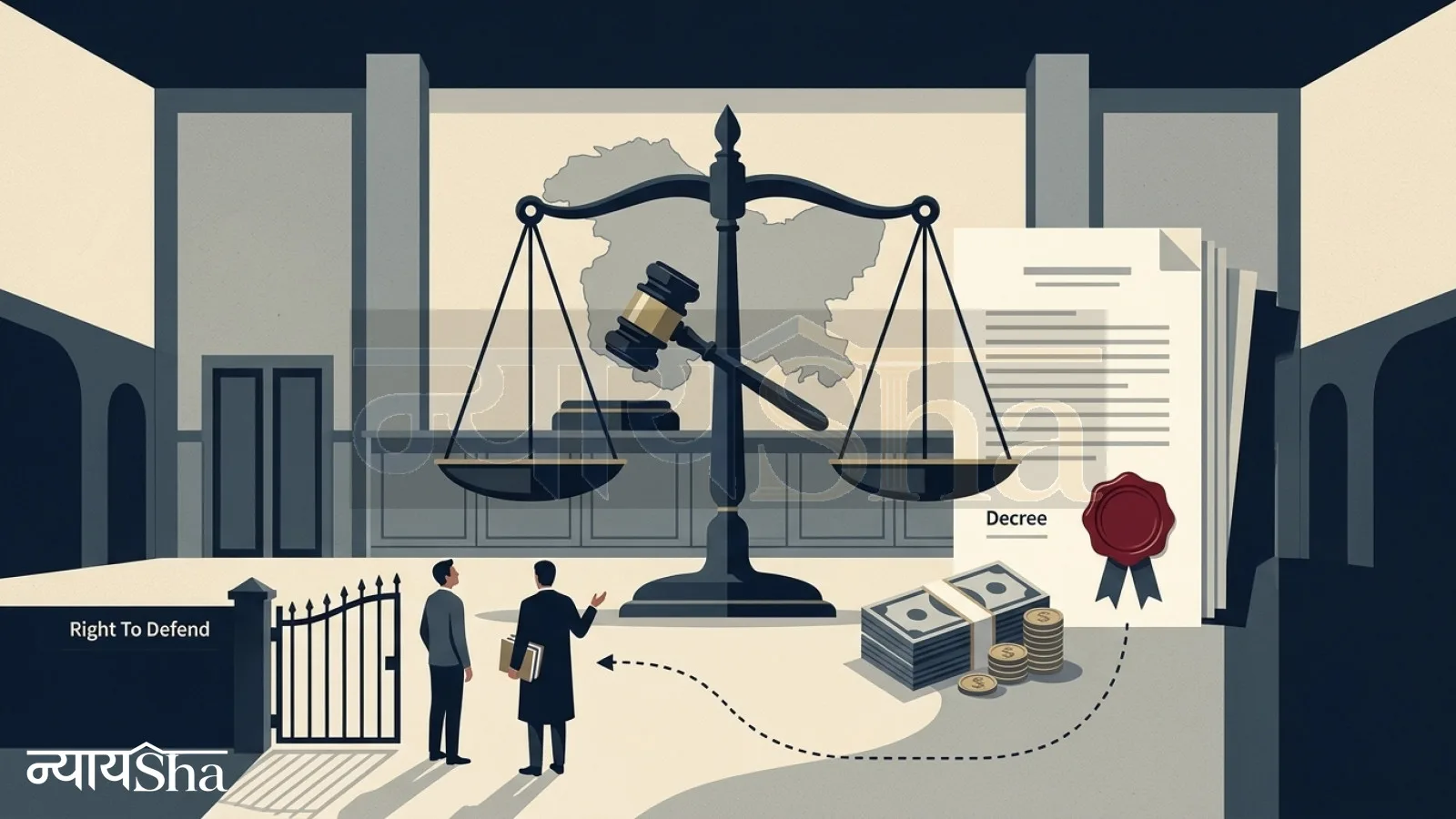
The High Court of Jammu & Kashmir and Ladakh at Srinagar has ruled that depositing the balance amount only after a decree has already been passed does not amount to retrospective compliance with a conditional order, and therefore cannot restore a defendant's right to contest a suit under Order XXXVII of the Code of Civil Procedure.
A bench of Justice Moksha Khajuria Kazmi dismissed a Civil First Appeal filed by the Union Territory of Jammu and Kashmir and others, finding no error or illegality in the trial court's decision to decree a summary suit in favour of the plaintiffs for Rs. 57.23 lacs along with interest and costs.
Background Of The Dispute
The respondents, who were the original plaintiffs, had claimed to have carried out electrical works worth Rs. 37.82 lacs at the MLA Hostel in Srinagar. The expenditure was said to have been funded by the Legislative Assembly Secretariat and routed through the Directorate of Estates, with no public tenders floated for the work.
Invoking Order XXXVII CPC, the plaintiffs filed a summary suit seeking recovery of Rs. 57.32 lacs for the work allegedly performed.
The Estates Department sought leave to defend the suit. The Additional District Judge (Bank Cases), Srinagar, allowed this request but made it conditional on the appellants depositing Rs. 37.82 lacs with the court. A challenge to this conditional order before the High Court was unsuccessful.
After that setback, the appellants deposited only Rs. 19.01 lacs by cheque and sought information from the Treasury Officer regarding available funds to pay the rest. Because the remaining amount was not deposited within the time fixed, the trial court went ahead and decreed the suit entirely in the plaintiffs' favour.
Arguments Before The High Court
The appellants argued that they had already deposited a significant chunk of the directed amount and that the trial court had overlooked the peculiar circumstances that caused the delay in paying the balance.
The respondents countered that the appellants had themselves admitted, in their leave-to-defend application, that works worth Rs. 37.82 lacs had indeed been executed. They further pointed out that the shortfall was eventually deposited only in 2025 — well after the impugned judgment and decree had already been passed.
What The Court Found
The Court noted that the trial court's leave to defend was conditional on two things: depositing Rs. 37.82 lacs and filing a written statement within thirty days. Of this, the appellants paid Rs. 19,01,000 on 26.03.2023, while the balance of Rs. 18,81,000 was paid only on 25.07.2025.
Since this compliance came long after the stipulated deadline, the Court held that the appellants had clearly failed to meet the condition attached to the leave to defend within time. It observed that such a failure justified the trial court's decision to go ahead and decree the suit.
Crucially, the Court held that depositing the shortfall after the decree had already been passed could not be treated as compliance taking retrospective effect, and such belated payment could not revive the defendants' extinguished right to contest the suit.
Finding no perversity or illegality in the trial court's judgment and decree, the High Court upheld the decree in full and dismissed the Civil First Appeal.
Related Reads
- J&K High Court Rejects Appeal Against Rent Deposit Order, Clarifies Scope of Order XXXIX Rule 10 CPC
- J&K&L HC Dismisses Dharmarth Trust's Recall Plea Over Death
- J&K&L HC Quashes FIR In Railway Contract Dispute, No Forgery
- J&K&L HC Grants FCI Employees One Last Chance In Hindi Typing Test
- J&K High Court: Date Mismatch In Sanction Order Alone Insufficient To Scuttle Corruption Charge-Sheet
Follow Nyaysha
Fresh legal updates across our platforms — follow wherever you already scroll.
LinkedInJudgments, appointments & career moves — for professionals Follow Instagram@nyaysha.in — visual explainers, reels & court-room snapshots Follow FacebookCommunity discussions & week-in-review roundups Follow TelegramLegal jobs, internships, moot courts, competitions, events & call for papers — instant alerts, first to know Join